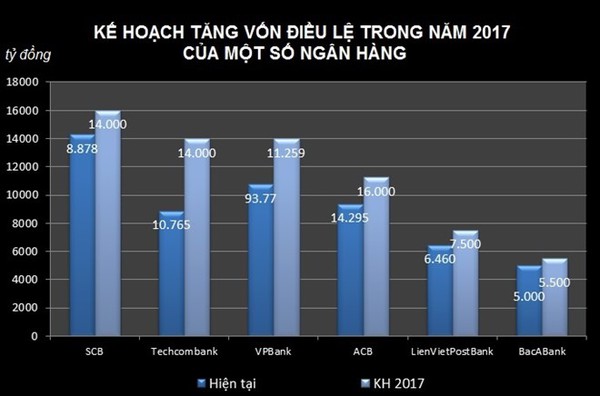
In addition to setting a relatively high growth target over 2016 this year, many banks have set a goal to increase chartered capital in various forms.
Increased capital
On April 10th, two banks - ACB and VPBank will hold the annual shareholders' meeting in 2017. Besides the prominent issues in each bank, these two banks also submit the plan to increase charter capital In 2017.
Specifically, ACB Board of Directors submits shareholders to increase charter capital to 11,259 billion. This increase is nearly 20% in 2017, by dividing the share dividend by 10% to existing shareholders with the maximum number of nearly 98.6 million shares.
By the end of 2016, chartered capital of ACB reached VND 9,377 billion and belongs to the group of leading private commercial banks with chartered capital.
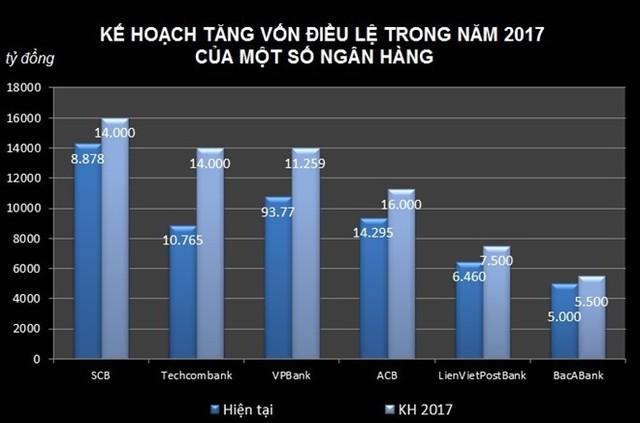
Bên cạnh các ngân hàng đã công bố kế hoạch tăng vốn cụ thể, nhiều ngân hàng cho biết cũng sẽ trình cổ đông phê duyệt phương án tăng vốn điều lệ trong năm 2017. Đồ họa: Quang Thắng.
Similarly, at VPBank, the bank leader also presents shareholders plan to increase charter capital to more than 14,000 billion. Currently, VPBank has a chartered capital of VND10,765 billion and equity of VND15,400 billion.
In 2017, VPBank will need to add about VND4,000 billion of chartered capital, to meet the bank's operational needs and ensure compliance with safety ratios stipulated by the State Bank of Vietnam.
VPBank will carry out 2 share issues to increase charter capital. The first issuance of 329.4 million shares, the chartered capital after this issuance is expected to reach more than 14,000 billion.
In the second tranche, the bank will issue up to 133.2 million shares (10% of common shares) at the maximum. The selling price will not be lower than the book value of the Bank.
The charter capital of this bank is in the top 10 private commercial joint stock banks, and is equivalent to ACB. However, if the successful phase 1 issuance, the capital of this bank will increase to the top 4, only after Sacombank, MBBank and SCB (Sai Gon Commercial Joint Stock Bank).
The General Meeting of Shareholders has not yet held, but in the meeting document, Techcombank also aims to increase charter capital to very high this year.
Specifically, Techcombank will submit a shareholder's plan to increase its chartered capital by VND5 trillion from VND8,878 billion to VND14,000 billion. Increasing capital through offering 500 million shares to existing shareholders in proportion of holding.
Offer period is expected in the second quarter or third quarter.
Other banks such as Vietcombank, SCB, LienVietPostBank, BacABank, OCB ... have a plan to increase charter capital this year. Previously, charter capital in most banks also increased significantly in 2016, when the SBV decided to apply the pilot standard Basel 2 at 10 CIs.
Increase capacity or ensure capital CAR?
The reason for the increase in chartered capital this year is to improve the risk management capacity in banking operations, improve the capacity to invest in system development and expand branch network. And increase investment ...
In addition, the main reason banks plan to hike their chartered capital in 2017 is to ensure capital adequacy ratio and performance indicators as regulated by the SBV.
Dam Van Tuan, deputy general director of ACB, said the increase of charter capital would help increase the limit related to credit extension for customers, additional medium and long term funding to finance credit activities. .
In this regard, financial experts believe that raising chartered capital at banks is mainly aimed at ensuring the capital adequacy ratio (CAR) in accordance with regulations.
Specifically, at present, CAR is regulated by SBV at 8%. In the Financial Market Review Report of 2016 by the National Financial Supervisory Commission, the CAR of the whole system is estimated at 11.3% (by 2015, 11.6%).
The results of application of Basel 2 capital adequacy standards in 10 pilot banks showed that the CAR was significantly reduced compared to the number of reports.As for the four state-owned JSBs, the CAR reportedly approached the 9% threshold, with Basel 2 falling below 8%. In the coming time, this group of banks will not be able to raise capital which will strongly affect the credit growth plan of the group as well as the credit growth of the whole sector.This could lead to the impact on economic growth in the period 2016-2020, which is a group of banks that have an important role and influence on the whole system of CIs.
In 2017, VPBank will need to add about VND4,000 billion of chartered capital, to meet the bank's operational needs and ensure compliance with safety ratios stipulated by the State Bank of Vietnam.
VPBank will carry out 2 share issues to increase charter capital. The first issuance of 329.4 million shares, the chartered capital after this issuance is expected to reach more than 14,000 billion.
In the second tranche, the bank will issue up to 133.2 million shares (10% of common shares) at the maximum. The selling price will not be lower than the book value of the Bank.
The charter capital of this bank is in the top 10 private commercial joint stock banks, and is equivalent to ACB. However, if the successful phase 1 issuance, the capital of this bank will increase to the top 4, only after Sacombank, MBBank and SCB (Sai Gon Commercial Joint Stock Bank).
The General Meeting of Shareholders has not yet held, but in the meeting document, Techcombank also aims to increase charter capital to very high this year.
Specifically, Techcombank will submit a shareholder's plan to increase its chartered capital by VND5 trillion from VND8,878 billion to VND14,000 billion. Increasing capital through offering 500 million shares to existing shareholders in proportion of holding.
Offer period is expected in the second quarter or third quarter.
Other banks such as Vietcombank, SCB, LienVietPostBank, BacABank, OCB ... have a plan to increase charter capital this year. Previously, charter capital in most banks also increased significantly in 2016, when the SBV decided to apply the pilot standard Basel 2 at 10 CIs.
Increase capacity or ensure capital CAR?
The reason for the increase in chartered capital this year is to improve the risk management capacity in banking operations, improve the capacity to invest in system development and expand branch network. And increase investment ...
In addition, the main reason banks plan to hike their chartered capital in 2017 is to ensure capital adequacy ratio and performance indicators as regulated by the SBV.
Dam Van Tuan, deputy general director of ACB, said the increase of charter capital would help increase the limit related to credit extension for customers, additional medium and long term funding to finance credit activities. .
In this regard, financial experts believe that raising chartered capital at banks is mainly aimed at ensuring the capital adequacy ratio (CAR) in accordance with regulations.
Specifically, at present, CAR is regulated by SBV at 8%. In the Financial Market Review Report of 2016 by the National Financial Supervisory Commission, the CAR of the whole system is estimated at 11.3% (by 2015, 11.6%).
The results of application of Basel 2 capital adequacy standards in 10 pilot banks showed that the CAR was significantly reduced compared to the number of reports.As for the four state-owned JSBs, the CAR reportedly approached the 9% threshold, with Basel 2 falling below 8%. In the coming time, this group of banks will not be able to raise capital which will strongly affect the credit growth plan of the group as well as the credit growth of the whole sector.This could lead to the impact on economic growth in the period 2016-2020, which is a group of banks that have an important role and influence on the whole system of CIs.